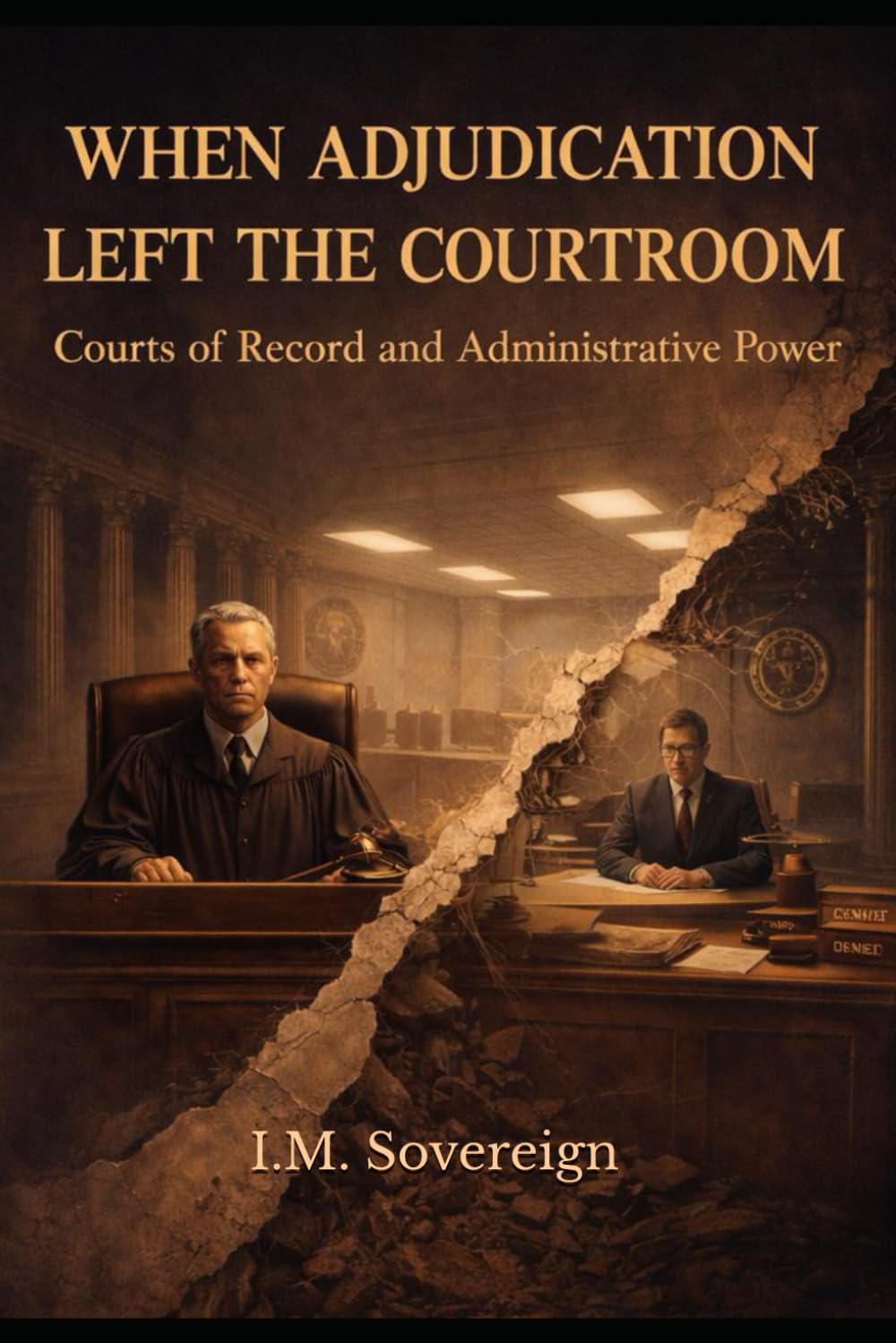
WHEN ADJUDICATION LEFT THE COURTROOM: WHEN ADJUDICATION LEFT THE COURTROOM (The Sovereignty Series) baixar epub
por I. M. Sovereign



Escolha um formato:
| zip | Baixar grátis |
|---|---|
| rar | Baixar grátis |
| epub | Baixar grátis |
| Baixar grátis | |
| lit | Baixar grátis |
| odf | Baixar grátis |
Descrição do livro
WHEN ADJUDICATION LEFT THE COURTROOM is a forensic examination of a transformation most people sense but cannot quite name: the quiet migration of adjudication from courts of record into administrative enforcement systems—and the consequences of mistaking one for the other. This book does not argue that courts have disappeared. It shows something more unsettling. Courts remain, but they are no longer the primary institutions through which liability is declared, facts are found, and penalties are imposed. Those functions now occur, routinely and lawfully, inside executive agencies operating under the language and appearance of adjudication while lacking its constitutional structure. Administrative judges are not judges in the constitutional sense. Administrative courts are not courts of record. They were not historically understood as such, and they exercise authority only because they are classified as executive enforcement forums rather than judicial tribunals. Yet they adopt judicial titles, rituals, and vocabulary—borrowing the legitimacy of judging without its constraints. Through a disciplined institutional analysis, this book explains how that substitution occurred. It traces the shift from common-law adjudication to regulatory enforcement, from jury fact-finding to internal determination, from due process as a condition of authority to due process as a managerial standard. It shows why doctrines such as corpus delicti, jury trial, and neutral adjudication did not vanish through repeal, but through reclassification. This is not protest literature. It does not rely on outrage, conspiracy, or motive. It relies on constitutional text, Supreme Court doctrine, statutory design, and institutional structure. The conclusion is unavoidable: a system that calls itself adjudication while operating as governance changes what law is experienced to be. Readers will come away with clarity—about why so many legal proceedings feel unjust despite being declared constitutional, why “judges” now often function within prosecutorial hierarchies, and why judicial review can preserve legality without restoring judgment. This book explains, without euphemism, how adjudication left the courtroom—and what was lost when it did.






Autores populares
Icon Group International (402) Publishing lmgdaw (341) Nikolay Krechet (266) Unknown Author (197) Lyudmil Tsvetkov (179) Barrett Williams (166) Kennie B Journals (158) Riddler Books (122) ChatGPT ChatGPT (118) NAK Legal Publishing (116) Evgeniia Naumchenko (114) Vários Autores (112) Sharifa McFarlane (97) Jillo Trukudo (96) Quick Witted Coconut (94) Roggie Clark (94) Mint and Cherry Notebooks (93) Marina Buchholz B.Eng (89) Iwona Makara (87) Mary Hirose (87)