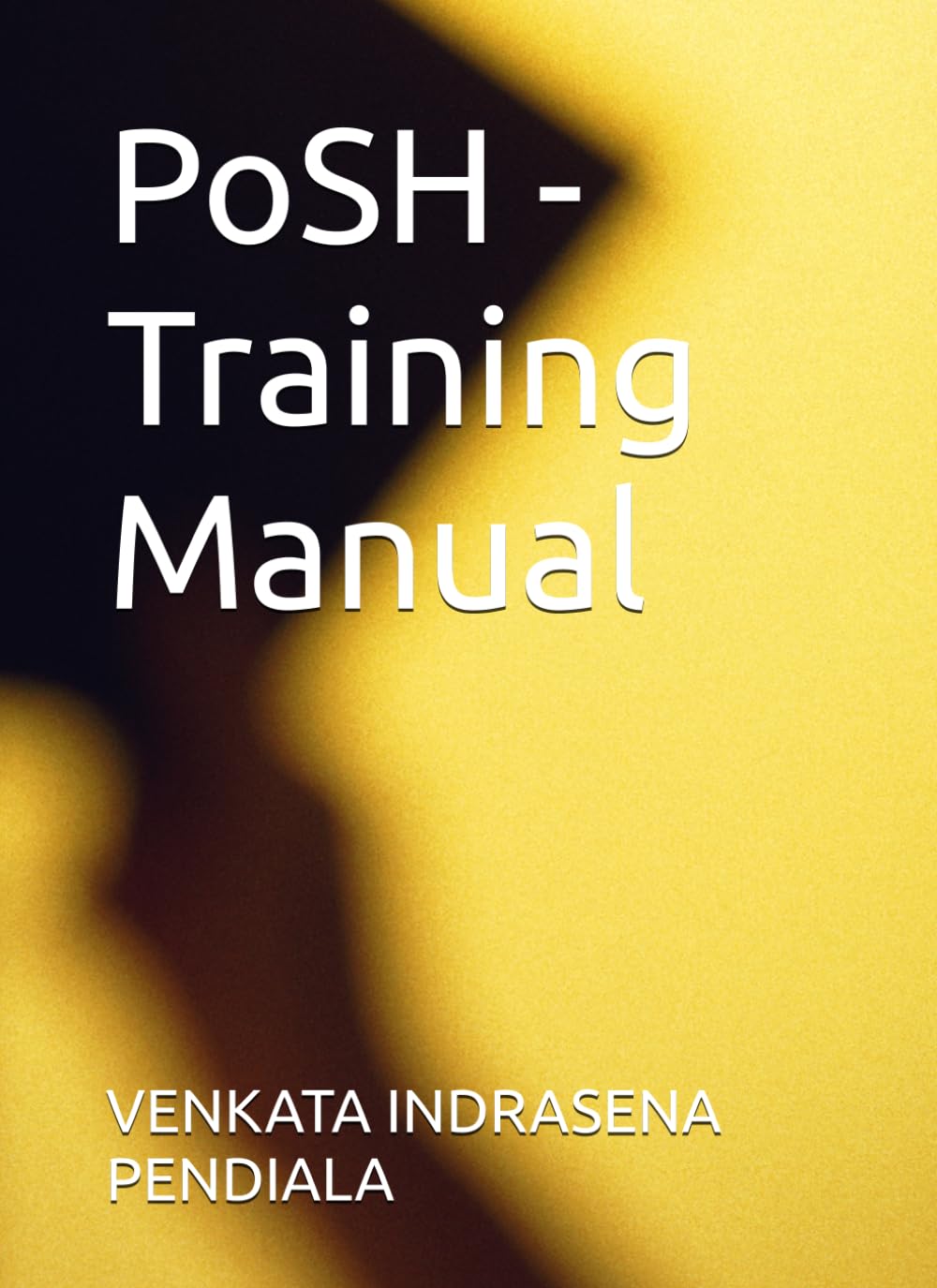
PoSH -Training Manual odf de graça baixar
por Dr VENKATA INDRASENA PENDIALA



Escolha um formato:
| zip | Baixar grátis |
|---|---|
| rar | Baixar grátis |
| epub | Baixar grátis |
| Baixar grátis | |
| lit | Baixar grátis |
| odf | Baixar grátis |
Descrição do livro
Brief Description of the PoSH Training Manual and Case-Law Workshop The Comprehensive Training Programme on Prevention, Prohibition & Redressal of Sexual Harassment at the Workplace (PoSH) is a structured training and reference manual designed for employees, managers, supervisors, HR professionals, Internal Committee (IC) members, Legal Compliance Officers and organisational leaders. It brings together the legislative framework, judicial precedents, complaint procedures, employer responsibilities and practical compliance measures required for a safe and legally compliant workplace. The manual is organised into eight modules covering the legislative background and constitutional provisions; Vishaka Guidelines and the PoSH Act, 2013; understanding sexual harassment and its different forms; rights and duties of all parties; constitution and functioning of Internal and Local Complaints Committees; complaint and inquiry procedures; landmark case laws; penalties and appeals; employer obligations; and development of a PoSH-compliant organisational culture. A major feature of the programme is its case-law-based practical learning approach. The manual incorporates more than thirty significant Supreme Court and High Court judgments and uses them to demonstrate how PoSH principles operate in real workplace situations. The workshop examines ten selected cases covering critical legal and procedural principles. Vishaka v. State of Rajasthan establishes the constitutional foundation of workplace sexual-harassment law. Apparel Export Promotion Council v. A.K. Chopra demonstrates that physical contact is not essential and that unwelcome sexual conduct may take different forms. Medha Kotwal Lele v. Union of India emphasises effective implementation and compliance. The next cases focus on fair and competent IC proceedings. Aureliano Fernandes v. State of Goa addresses natural justice and procedural fairness. Ruchika Singh Chhabra v. Air France India highlights the importance of trained IC members and adequate opportunity to be heard. P. Rajeswari v. State of Tamil Nadu deals with proper IC constitution and the external member requirement. The remaining cases address essential safeguards: X v. Tata Consultancy Services Ltd. on confidentiality; Nisha Priya Bhatia v. Union of India on timely inquiry; Sudha Devi v. M.P. Public Service Commission on impartiality and conflict of interest; and Dhanwanthari Chandran v. Union of India on distinguishing an unproved complaint from a malicious or knowingly false complaint. The workshop methodology is participant-centred. Participants receive the facts and questions without the answers. Through individual or group discussion, they identify the legal issues, applicable PoSH principles, rights of both parties, evidence and procedural requirements, and determine the appropriate course of action for the IC. The facilitator subsequently discusses the relevant judicial principles and compares them with the participants' conclusions. The programme aims to develop practical competence, enabling participants to handle complaints sensitively, maintain confidentiality, ensure natural justice, avoid bias, follow statutory timelines, evaluate evidence and prepare reasoned findings. Ultimately, the manual seeks to move organisations beyond mere statutory compliance towards a workplace culture based on dignity, equality, safety, respect and psychological security.








Autores populares
Icon Group International (402) Publishing lmgdaw (341) Nikolay Krechet (266) Unknown Author (197) Lyudmil Tsvetkov (179) Barrett Williams (166) Kennie B Journals (158) Riddler Books (122) ChatGPT ChatGPT (118) NAK Legal Publishing (116) Evgeniia Naumchenko (114) Vários Autores (112) Sharifa McFarlane (97) Jillo Trukudo (96) Quick Witted Coconut (94) Roggie Clark (94) Mint and Cherry Notebooks (93) Marina Buchholz B.Eng (89) Iwona Makara (87) Mary Hirose (87)