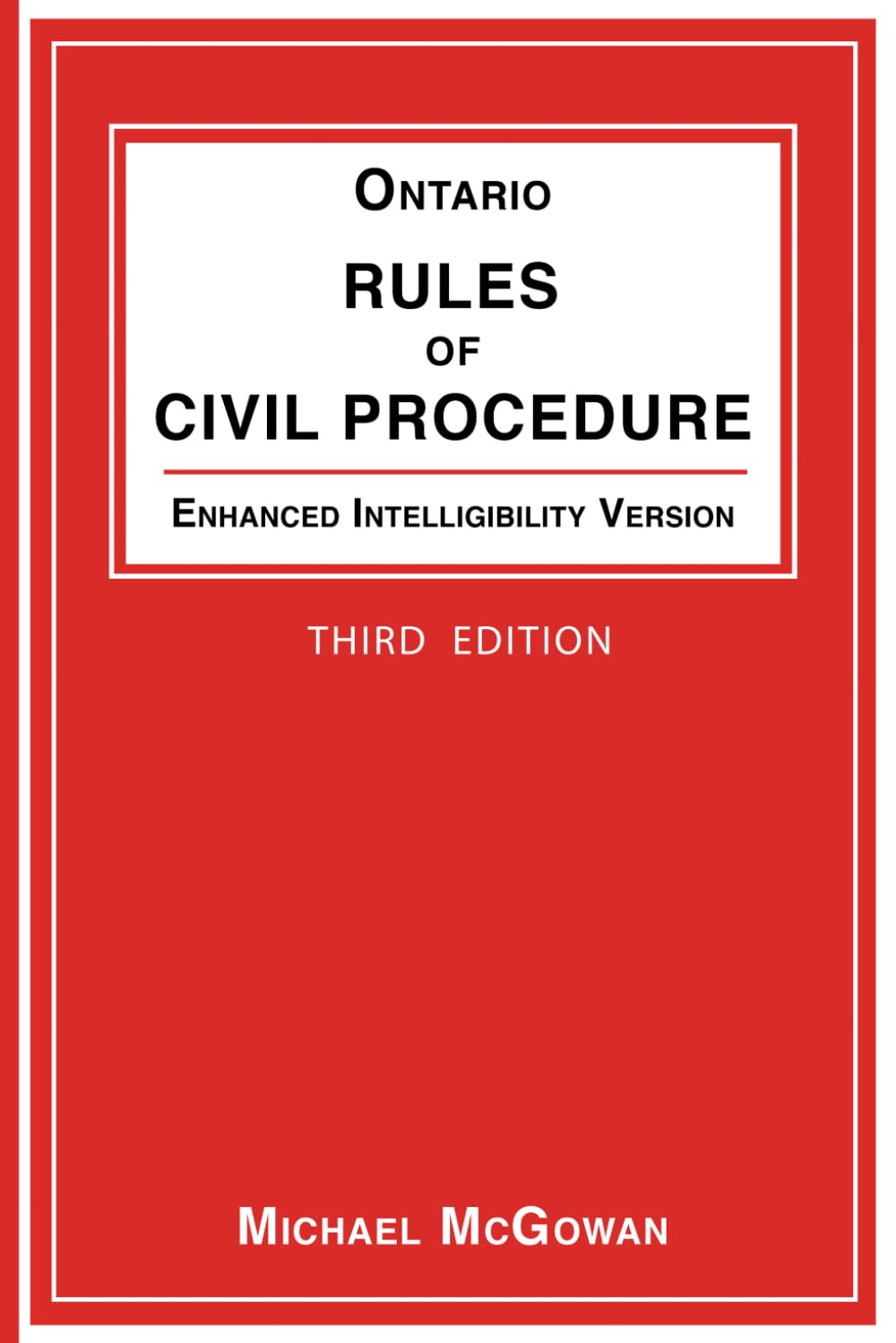
Ontario Rules of Civil Procedure, Enhanced Intelligibility Version (Enhanced Intelligibility Law Books) pdf baixar
por Michael McGowan



Escolha um formato:
| zip | Baixar grátis |
|---|---|
| rar | Baixar grátis |
| epub | Baixar grátis |
| Baixar grátis | |
| lit | Baixar grátis |
| odf | Baixar grátis |
Descrição do livro
Third Edition. This third edition of the enhanced intelligibility version of the Ontario Rules of Civil Procedure presents the rules in a format which maximizes readability and optimizes the reader’s comprehension and retention of the rules. This edition includes amendments made by O. Reg. 275/26 in force September 1, 2026.
Includes Primer for Self-Represented Litigants. This book is not only for lawyers, law students, paralegals and legal assistants. It is also useful for self-represented litigants.
Why is this book available only in paper format? Cognitive research has found that compared to reading an electronic book, reading a printed book provides deeper focus, higher comprehension, better retention and less eyestrain. Ask your AI for detailed reasons.
A free, downloadable digital copy of the rules is available from the Ontario government website. It is, no doubt, a useful tool for electronic searches, skimming the material and double checking your memory of a specific point. But to gain a deep understanding of the material, this paper version is simply superior. And it permits you to flip back and forth easily between rules, add underlining or highlighting, attach sticky notes, and make handwritten annotations.
How does this book enhance intelligibility? One intelligibility enhancement technique is generous use of white space. Cognitive researchers have found that use of white space can increase reader comprehension by up to 20%. Again, ask your AI for details.
A second technique is elimination of visual clutter. The R.R.O. and O. Reg. citations that follow many rules in the Ontario government version of the rules, and in those of conventional law book publishers, have been removed. Similarly, references to revoked rules have been deleted. The reader rarely needs such information and it clutters the page.
A third method to enhance reader comprehension is keeping the headings of subrules on separate lines. Conventional law book publishers often cram the heading between the number of the rule and the text of the rule. This makes it more difficult for the reader to scan for relevant headings and is unfaithful to the official text of the rules, which places the headings on separate lines.
Other factors affecting legibility and intelligibility include choices made about use of fonts, indentation and alignment of the text. For example, the rules in this book are left-aligned but not right-aligned, leaving a “ragged” right margin, which makes the text more readable. Ask your AI why.
Currency Note. The rules in this book are current to O. Reg. 275/26 in force September 1, 2026. An updated edition will be issued if and when there are substantial amendments.
About the author. Michael McGowan is a founding author of Watson & McGowan’s Ontario Civil Practice, was editor-in-chief of Carswell’s Practice Cases from 1984 to 2022 and appeared as lead counsel in such cases as Hollick v. Toronto (City), 2001 SCC 68, Garland v. Consumers' Gas Co., 2004 SCC 25 and Robertson v. Thomson Corp., 2006 SCC 43.











Autores populares
Icon Group International (402) Publishing lmgdaw (341) Nikolay Krechet (266) Unknown Author (197) Lyudmil Tsvetkov (179) Barrett Williams (166) Kennie B Journals (158) Riddler Books (122) ChatGPT ChatGPT (118) NAK Legal Publishing (116) Evgeniia Naumchenko (114) Vários Autores (112) Sharifa McFarlane (97) Jillo Trukudo (96) Quick Witted Coconut (94) Roggie Clark (94) Mint and Cherry Notebooks (93) Marina Buchholz B.Eng (89) Iwona Makara (87) Mary Hirose (87)