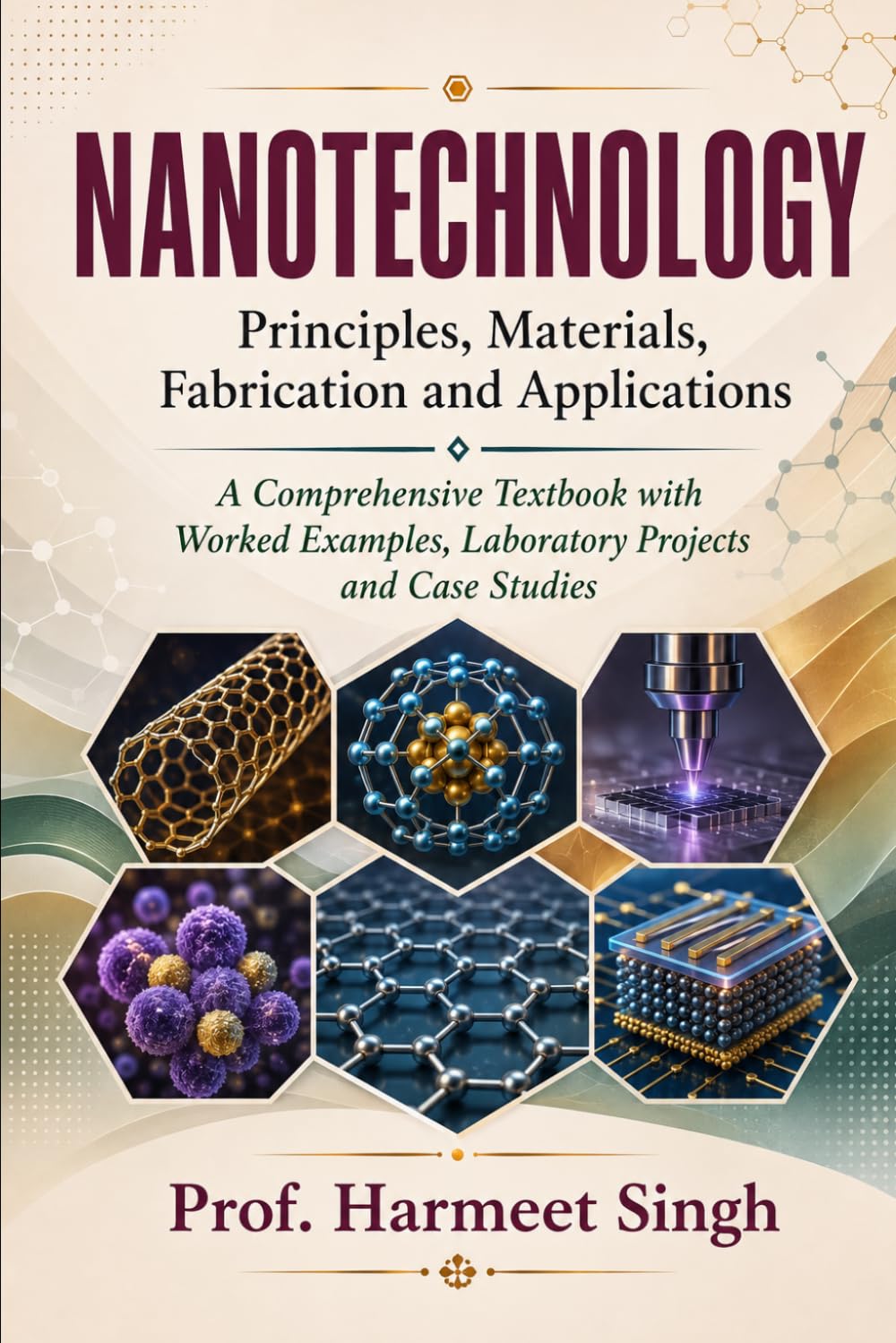
NANOTECHNOLOGY: Principles, Materials, Fabrication and Applications baixar epub
por Prof Harmeet Singh



Escolha um formato:
| zip | Baixar grátis |
|---|---|
| rar | Baixar grátis |
| epub | Baixar grátis |
| Baixar grátis | |
| lit | Baixar grátis |
| odf | Baixar grátis |
Descrição do livro
Nanotechnology has passed from novelty to infrastructure. The transistors in the device on which this sentence was typed have critical dimensions of a few nanometres. The vaccines that ended the acute phase of a global pandemic were delivered inside lipid nanoparticles some eighty nanometres across. The sunscreen on a child's shoulder, the anti-reflective coating on a pair of spectacles, the catalytic converter beneath a car and the cathode of the battery in an electric vehicle all depend on engineered nanoscale structure. A graduate in any branch of science or engineering will encounter this technology, and will be expected to reason about it competently.
This book grew out of a two-semester course taught to senior undergraduates and first-year postgraduates drawn from physics, chemistry, materials science, electrical engineering, mechanical engineering and biotechnology. Such an audience makes uniform assumptions impossible. I have therefore tried to write a book that begins each topic from first principles, develops the quantitative apparatus carefully, and always returns to a concrete application. A reader with a solid grounding in undergraduate physics and chemistry should be able to follow every derivation in these pages without recourse to another text.
Three convictions shaped the writing. The first is that nanotechnology is best taught as physics and chemistry made visible rather than as a catalogue of materials. The mechanisms introduced in Chapters 2 to 4 — surface energy, quantum confinement, the changed hierarchy of forces, the electrical double layer — recur in every subsequent chapter, and a reader who understands them deeply will be able to predict the behaviour of materials that have not yet been invented. The second is that no one understands a subject until they have calculated something with it. The book therefore contains worked examples with complete arithmetic, numerical problems at the end of every chapter, and extended mini-projects that ask the reader to design, estimate and justify rather than merely recall. The third is that a technology that touches human health and the environment must be taught together with its risks and its governance, which is why Chapters 23 and 24 are as substantial as those on devices.
The book is organised in six parts. Part I establishes the physical and chemical foundations. Part II surveys nanomaterials by dimensionality, from quantum dots to graphene to bulk nanostructured solids. Part III treats synthesis and fabrication, both bottom-up and top-down. Part IV is devoted to characterisation, on the principle that a nanostructure one cannot measure is a nanostructure one does not have. Part V covers devices and applications across electronics, photonics, energy, medicine, the environment and sensing. Part VI addresses toxicology, safety, regulation, commercialisation and the future of the field.
Every chapter follows the same structure: learning objectives, a developed treatment with figures and tables, at least one fully worked numerical example, a summary of key results, conceptual review questions, quantitative problems, a mini-project suitable for coursework or laboratory work, and a short list of further reading. Instructors may treat the parts as modules; a one-semester course can be assembled from Parts I, II and V, while a laboratory-oriented course might combine Parts III and IV with the projects.
I am indebted to the students whose questions exposed every unclear explanation in the early drafts, to colleagues who reviewed individual chapters, and to the many researchers whose published work forms the evidential basis of this text. Errors that remain are mine alone, and I will be grateful to any reader who takes the trouble to report them.









Autores populares
Icon Group International (402) Publishing lmgdaw (341) Nikolay Krechet (266) Unknown Author (197) Lyudmil Tsvetkov (179) Barrett Williams (166) Kennie B Journals (158) Riddler Books (122) ChatGPT ChatGPT (118) NAK Legal Publishing (116) Evgeniia Naumchenko (114) Sharifa McFarlane (97) Jillo Trukudo (96) Quick Witted Coconut (94) Roggie Clark (94) Mint and Cherry Notebooks (93) Marina Buchholz B.Eng (89) Iwona Makara (87) Mary Hirose (87) Kingston Publishing (85)