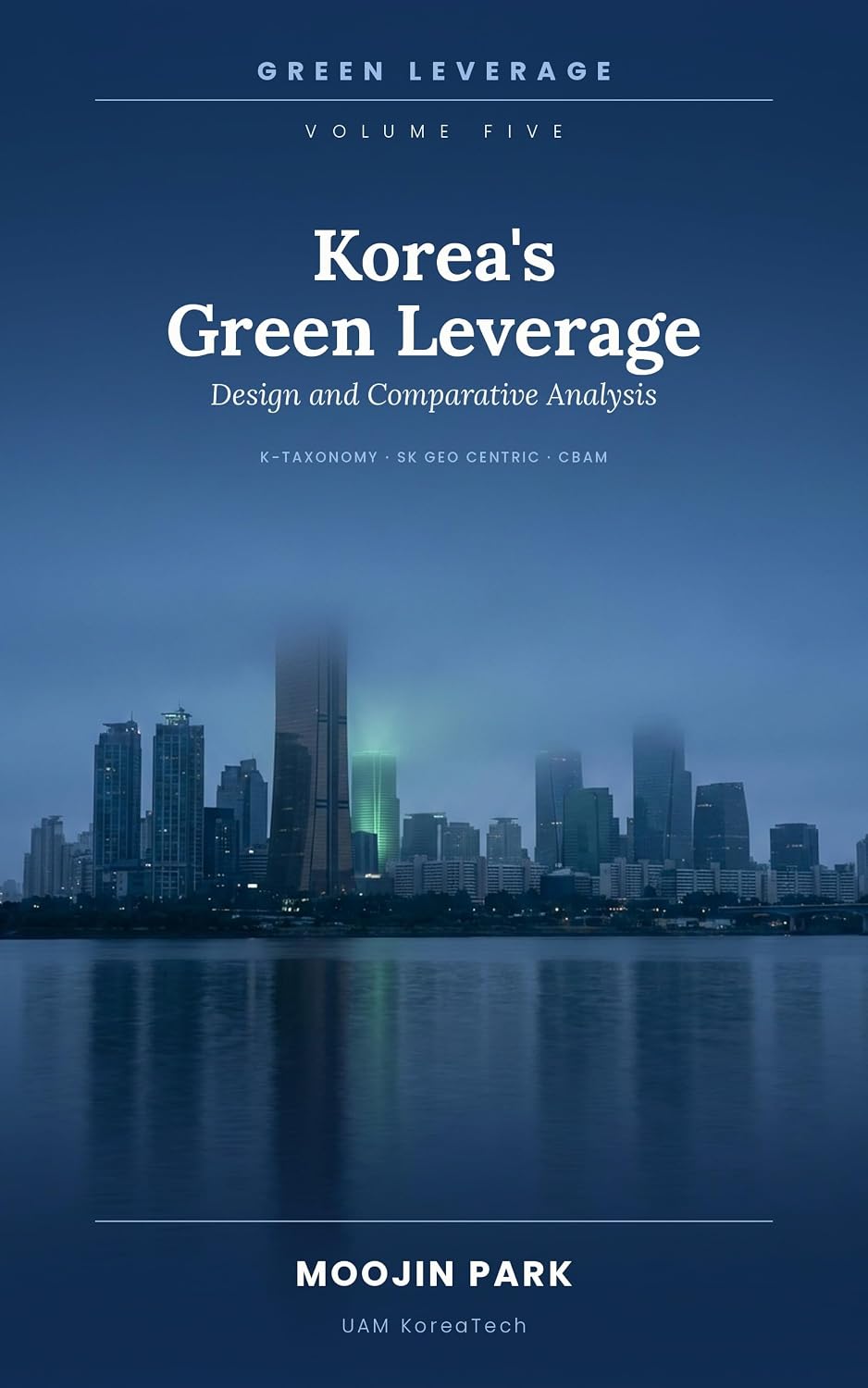
Moojin Park Korea's Green Leverage: Design and Comparative Analysis (English Edition) lit
por Moojin Park



Leia uma amostra
Escolha um formato:
| zip | Baixar grátis |
|---|---|
| rar | Baixar grátis |
| epub | Baixar grátis |
| Baixar grátis | |
| lit | Baixar grátis |
| odf | Baixar grátis |
Descrição do livro
Abstract Green finance is usually taught from a global template and then applied to Korea with adjustments. This volume reverses that. It takes the analytical spine of the series and rebuilds it inside Korean institutions - the K-Taxonomy, the public-finance engine, the domestic green-bond and sustainability-linked market, and the exporter's exposure to CBAM - to answer a single question: where, specifically, does a Korean project find cheaper capital? A Korean operator with a genuine decarbonization case cannot tell which door to knock on. Public and private tracks overlap, taxonomy alignment is asserted rather than demonstrated, and the international framing that fills the literature does not name the institution that will actually write the check. Global handbooks describe instruments Korea prices differently. Domestic guidance describes programs without the finance logic that decides between them. Neither tells an operator how to match a project to a funding track, and neither treats a regulatory gap as anything other than a problem to wait out. The book maps the Korean green-finance landscape, then puts the K-Taxonomy to work in practice rather than in principle. It examines the public-finance engine that carries much of the domestic market, and reads four Korean situations closely: the chemical transition at SK Geo Centric, public-housing finance and the Korean retrofit, the green REIT and the domestic investor, and the exporter's decarbonization case. It sets a global comparison against a Korean developer, then makes its central move - treating regulatory gaps as opportunities rather than obstacles. The CBAM channel is taken in depth as the mechanism that converts an EU rule into a Korean cost of capital. A design playbook and a track-matching chapter follow, then the domestic green-bond and sustainability-linked market, risk and guardrails, and a roadmap. Fifteen chapters carry the argument, closing the five-volume series. The reference half is deliberately operational: a Korean design worksheet, a project-finance checklist, the Korean cost-of-capital stack, a public-versus-private decision note, how to read a Korean sustainability-linked instrument, the demonstration-to-scale bridge, a mapping of the series spine to Korean institutions, a note on enforcement and trust, worked transactions end to end, and an analyst's one-page Korea brief. Two claims carry the volume. First, a Korean project is financed by matching, not by merit: the same case priced against the wrong track fails and against the right one clears. Second, the interval before a rule hardens is the cheapest capital available - the gap is the opportunity, and it closes. Readers should expect a funding track named, a worksheet filled, and a defensible sequence rather than a general endorsement of green finance. Korean operators, developers and exporters building a decarbonization funding case; policy-bank, commercial-bank and investment teams underwriting domestic green transactions; ESG and IR leads preparing taxonomy-aligned disclosure; and analysts comparing Korean practice with the global market. Moojin Park is chief executive of UAM KoreaTech and writes on the economics of environmental performance. This is Volume 5, the closing volume, of Green Leverage. Worked examples are illustrative and every figure carries its verification level; the book describes a method of analysis and is not investment, tax, or legal advice.






Autores populares
Icon Group International (402) Publishing lmgdaw (341) Nikolay Krechet (266) Unknown Author (196) Lyudmil Tsvetkov (179) Barrett Williams (166) Kennie B Journals (158) Сергей Каледин (148) Riddler Books (122) ChatGPT ChatGPT (118) NAK Legal Publishing (116) Evgeniia Naumchenko (114) Sharifa McFarlane (97) Jillo Trukudo (96) Quick Witted Coconut (94) Roggie Clark (94) Mint and Cherry Notebooks (93) Marina Buchholz B.Eng (89) Iwona Makara (87) Mary Hirose (87)