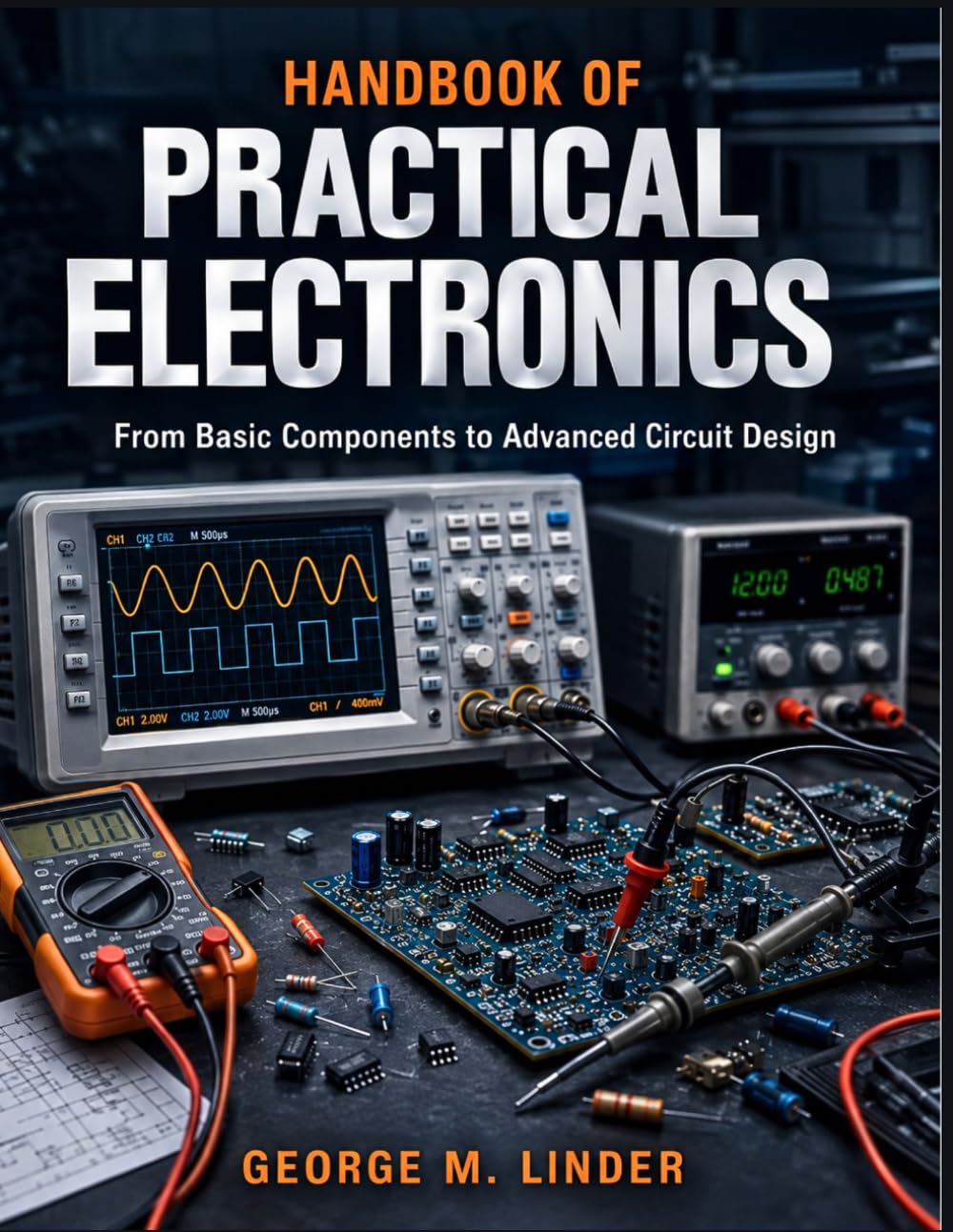
George M. Linder HANDBOOK OF PRACTICAL ELECTRONICS: From Basic Components to Advanced Circuit Design lit
por George M. Linder



Escolha um formato:
| zip | Baixar grátis |
|---|---|
| rar | Baixar grátis |
| epub | Baixar grátis |
| Baixar grátis | |
| lit | Baixar grátis |
| odf | Baixar grátis |
Descrição do livro
A circuit that works by accident is a circuit you cannot fix.
Most people learning electronics end up stranded on one side of a divide. Theory-first textbooks derive the equations but never put a probe on a live board, so a reader can calculate a filter's cutoff frequency and still have no idea why the filter in front of them behaves nothing like the curve on the page. Project-first guides do the opposite: they walk through a build without explaining why those values were chosen, so the moment a circuit misbehaves there is nothing to reason from. Technicians meet this wall when a fault matches no example they have seen. Students meet it when a bench measurement contradicts a calculation.
This handbook develops theory and practice as a single subject across sixteen progressive chapters, moving from the physical meaning of charge and current to a finished, enclosed, repairable piece of equipment. You can follow a signal the whole way: from an AC input, through rectification and regulation to a stable DC rail, into an amplifier stage, out to a microcontroller pin, through a filter, and onto a board you have laid out, soldered, tested, and repaired yourself.
Inside the book
Electrical quantities and circuit theory; resistors, capacitors, and inductors; DC and AC circuit analysis; diodes and semiconductor fundamentals; bipolar junction transistors; field-effect transistors and switching applications; operational amplifiers and linear applications; power supplies and voltage regulation; digital logic; combinational and sequential circuits; microcontrollers and embedded interfacing; signal processing and filter design; printed circuit board design and layout; test equipment, measurement, and troubleshooting; and circuit construction, repair, and practical project design.
Practicing electronics technicians who need a dependable bench reference for analysis and fault finding. Engineering students who want a practical companion alongside more theoretical coursework. Advanced hobbyists working toward professional-level skill. The mathematics stays at algebra and basic trigonometry, and where a calculus idea is unavoidable it is explained well enough that a reader without that background can still follow the reasoning and use the result.
Open it at Chapter 1, or at the chapter where your current problem lives, and start building the kind of understanding that survives contact with a real circuit board.








Autores populares
Icon Group International (402) Publishing lmgdaw (341) Nikolay Krechet (266) Unknown Author (197) Lyudmil Tsvetkov (179) Barrett Williams (166) Kennie B Journals (158) Riddler Books (122) ChatGPT ChatGPT (118) NAK Legal Publishing (116) Evgeniia Naumchenko (114) Sharifa McFarlane (97) Jillo Trukudo (96) Quick Witted Coconut (94) Roggie Clark (94) Mint and Cherry Notebooks (93) Marina Buchholz B.Eng (89) Iwona Makara (87) Mary Hirose (87) Kingston Publishing (85)