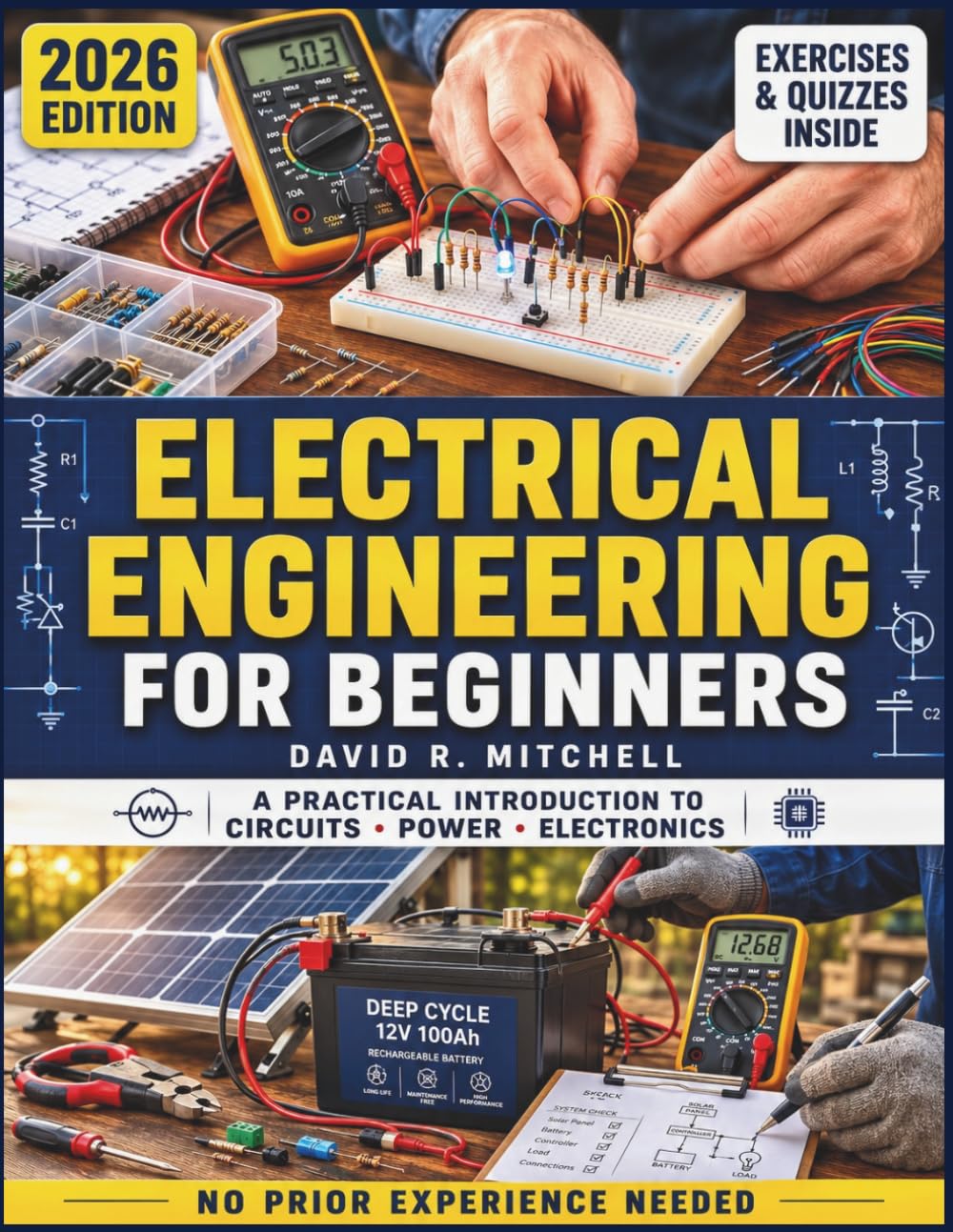
David R Mitchell Electrical Engineering for Beginners: A Practical Introduction to Circuits, Power, and Electronics lit
por David R Mitchell



Escolha um formato:
| zip | Baixar grátis |
|---|---|
| rar | Baixar grátis |
| epub | Baixar grátis |
| Baixar grátis | |
| lit | Baixar grátis |
| odf | Baixar grátis |
Descrição do livro
Electricity is invisible, and that is exactly why it is so easy to learn the formulas without ever understanding the circuit.
Most people who set out to learn electrical engineering stop in the first few weeks — not because the subject is beyond them, but because the explanations assume the steps they are missing. A formula appears with no derivation. A worked example jumps three lines of algebra. Notation changes from one source to the next. And the moment a circuit holds two sources instead of one, the familiar rules quietly stop working.This book takes the whole subject in one deliberate sequence, from what electric charge is to how an instrument reports a measurement. Notation is fixed in the first chapter and used unchanged to the last. Every relationship that matters is derived rather than quoted, and every chapter ends with problems that show whether the idea took hold: 282 worked examples solved step by step and 342 practice problems with a complete answer key, across fourteen chapters.What you will be able to do:
Practical judgement is developed alongside the mathematics: tolerance stacking and worst-case values, thermal limits and bias stability, non-sinusoidal waveforms, oscilloscope and multimeter behaviour, and the reasoning behind grounding, bonding, fusing and fault protection. The back matter adds a glossary of every key term and a consolidated list of symbols that flags where one letter carries more than one meaning.
It is written for self-taught beginners, students starting an engineering or technical programme, apprentices and technicians who want the theory behind their daily work, and makers who would rather understand a circuit than copy one. Comfort with algebra and a first acquaintance with derivatives is enough to follow every derivation. It is an educational text, not a substitute for a licensed professional on design or installation work.
Start at the first principle and work forward. Open this book, follow the derivations, solve the problems, and begin reading circuits with understanding instead of guesswork.








Autores populares
Icon Group International (402) Publishing lmgdaw (341) Nikolay Krechet (266) Unknown Author (197) Lyudmil Tsvetkov (179) Barrett Williams (166) Kennie B Journals (158) Riddler Books (122) ChatGPT ChatGPT (118) NAK Legal Publishing (116) Evgeniia Naumchenko (114) Sharifa McFarlane (97) Jillo Trukudo (96) Quick Witted Coconut (94) Roggie Clark (94) Mint and Cherry Notebooks (93) Marina Buchholz B.Eng (89) Iwona Makara (87) Mary Hirose (87) Kingston Publishing (85)