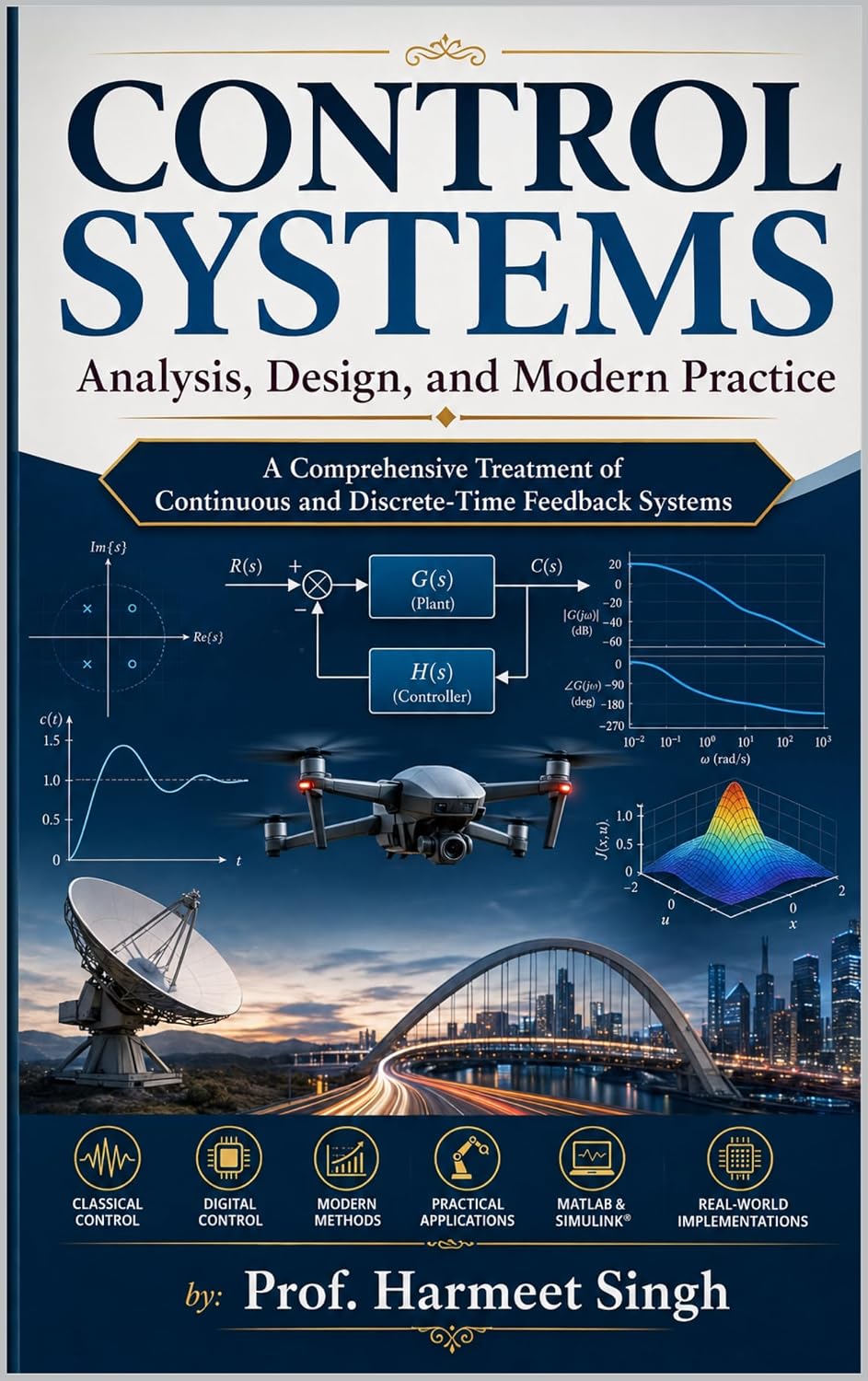
CONTROL SYSTEMS: Analysis, Design, and Modern Practice (English Edition) baixar epub
por Prof. Harmeet Singh



Leia uma amostra
Escolha um formato:
| zip | Baixar grátis |
|---|---|
| rar | Baixar grátis |
| epub | Baixar grátis |
| Baixar grátis | |
| lit | Baixar grátis |
| odf | Baixar grátis |
Descrição do livro
Control systems form one of the most enduring and unifying subjects in all of engineering. The same feedback principle that steadies an aircraft in turbulent air keeps a chemical reactor at temperature, holds a hard-disk head over its track, and regulates the voltage inside the device on which these words may be read. A student who masters the ideas of this subject acquires a way of thinking about dynamic systems that transfers effortlessly across disciplinary boundaries. That transferable habit of mind is the true reward of the study of control, and it is what this book sets out to cultivate.
This text has grown out of many years of teaching control systems to undergraduate students of electrical, electronics, mechanical, and instrumentation engineering. Throughout those years I have been guided by a simple conviction: that the beauty of control theory is lost when it is presented as a catalogue of disconnected recipes, and revealed when it is developed as a coherent story that moves from physical modelling, through analysis, to design. The chapters that follow attempt to tell that story in a deliberate order, each idea motivated by the limitations of the one before it.
The book is self-contained. It begins with the modelling of physical systems and the mathematics of the Laplace transform, develops the classical transform methods of Routh, Evans, Bode, and Nyquist in full, and then introduces the modern state-space viewpoint, digital control, and an outlook on nonlinear systems. Every major result is illustrated by worked examples drawn from realistic engineering situations, and every chapter closes with a summary and a set of review problems intended to consolidate understanding.
A distinctive feature of this edition is its extensive use of figures. Nearly every concept that can be visualised has been rendered as a diagram—block diagrams, response curves, root loci, Bode and Nyquist plots, pole–zero maps, and phase portraits—because the trained control engineer thinks in pictures as much as in equations. The many tables collect and compare results in a form convenient for revision and reference.
I have assumed that the reader has completed introductory courses in calculus, differential equations, and linear circuit theory. No prior exposure to control is required. The Laplace-transform review of Appendix A and the matrix-algebra review of Appendix B provide the mathematical background needed by those who wish to refresh it.
It is my hope that this book will serve not only as a course text but as a companion the reader returns to when, years later, a feedback loop must be tamed in the field. If it succeeds in conveying both the rigour and the pleasure of the subject, it will have done its work.











Autores populares
Icon Group International (402) Publishing lmgdaw (341) Nikolay Krechet (266) Unknown Author (196) Lyudmil Tsvetkov (179) Barrett Williams (166) Kennie B Journals (158) Сергей Каледин (148) Riddler Books (122) ChatGPT ChatGPT (118) NAK Legal Publishing (116) Evgeniia Naumchenko (114) Sharifa McFarlane (97) Jillo Trukudo (96) Quick Witted Coconut (94) Roggie Clark (94) Mint and Cherry Notebooks (93) Marina Buchholz B.Eng (89) Iwona Makara (87) Mary Hirose (87)