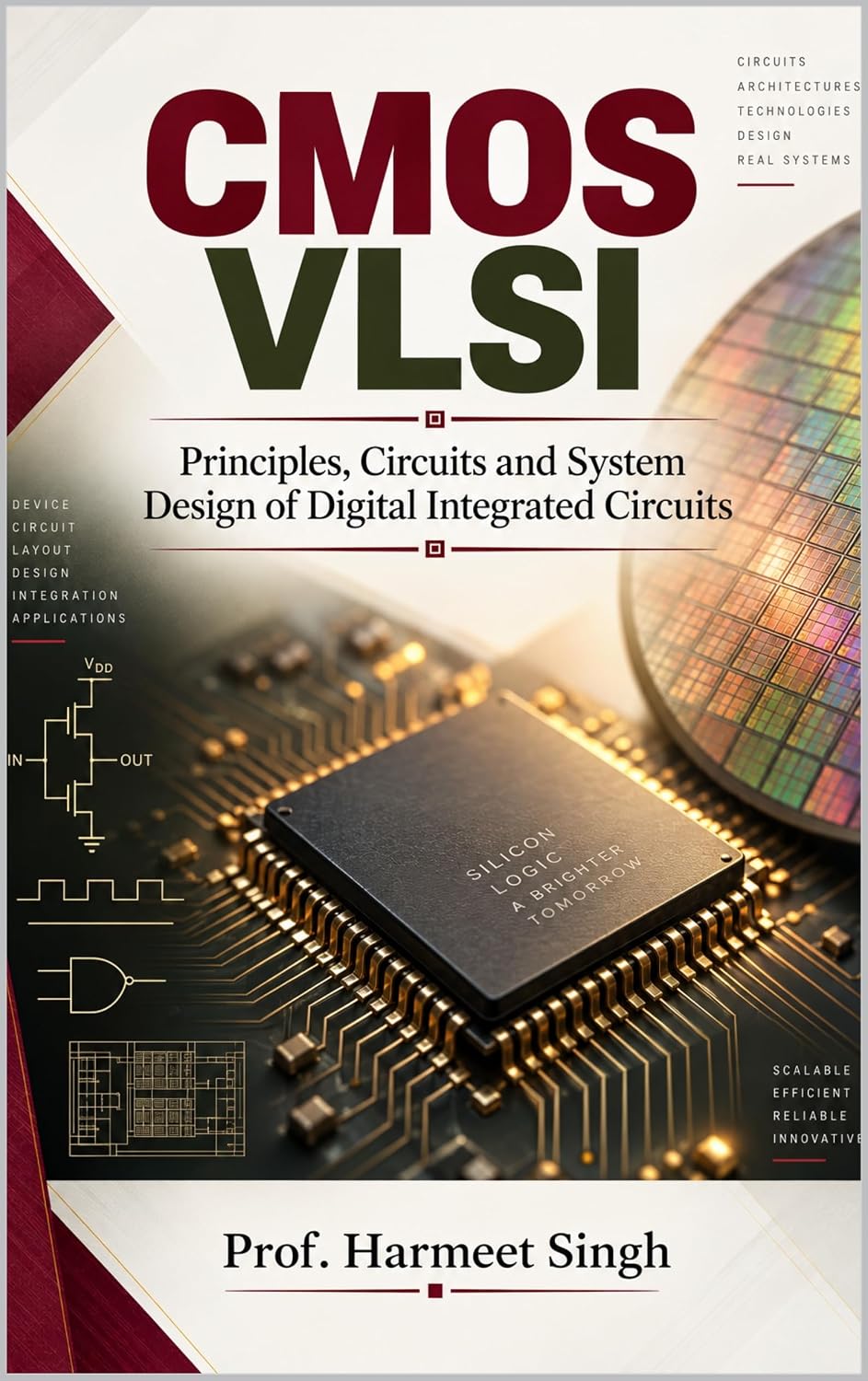
CMOS VLSI: Principles, Circuits and System Design of Digital Integrated Circuits (English Edition) baixar epub
por Prof. Harmeet Singh



Leia uma amostra
Escolha um formato:
| zip | Baixar grátis |
|---|---|
| rar | Baixar grátis |
| epub | Baixar grátis |
| Baixar grátis | |
| lit | Baixar grátis |
| odf | Baixar grátis |
Descrição do livro
This book is about how digital integrated circuits are designed in complementary metal-oxide-semiconductor technology. It is written for senior undergraduate and first-year postgraduate students of electronics and computer engineering, and for practising engineers who find themselves working one level of abstraction below or above their training and want a single coherent account of the whole field.
My reason for writing it is a frustration accumulated over many years of teaching. The subject is usually presented either as device physics with a few circuits appended, or as digital system design with the transistors hidden behind a library. Neither view is adequate. A designer who cannot estimate the delay of a gate on the back of an envelope will not know which architectural choice to make; a designer who does not know what a pipeline is for will size transistors that nobody needed. The interesting decisions in this field almost always sit at a boundary between two levels, and a textbook should therefore carry the reader across those boundaries repeatedly rather than settle comfortably at one of them.
The book is organised in five parts. Part I builds the foundations: what VLSI is and how it has scaled, how the MOS transistor works and how to model it at several levels of fidelity, how a chip is actually manufactured, and how a circuit becomes a set of polygons subject to design rules. Part II is circuit design proper: the inverter as the canonical gate, its static and dynamic behaviour, the logical-effort method for sizing, static CMOS combinational logic, the alternative logic families and their proper domains of use, and sequential elements with their timing constraints. Part III turns to the concerns that dominate real chips: power in all its components, interconnect that no longer behaves like an ideal wire, clock distribution, and the input–output and power-delivery circuits at the boundary of the die. Part IV constructs the subsystems from which processors are made — adders, multipliers, shifters, memories, datapaths and control. Part V closes the loop with testing and design for testability, the computer-aided design flow with hardware description languages, and a set of laboratory projects that exercise the entire book.
Three habits are cultivated throughout. The first is estimation: almost every quantitative section shows how to get an answer within twenty per cent using a model simple enough to hold in your head, before any simulator is opened. The second is physical reasoning: wherever a formula appears, the mechanism behind it is described, because formulas are forgotten and mechanisms are not. The third is design judgement: the book repeatedly asks not only how a circuit works but when it should be used, and it is candid about techniques — dynamic logic and pass-transistor families among them — whose textbook prominence exceeds their industrial use.
Worked examples are set in shaded boxes and are meant to be read, not skipped; they carry technique that is not repeated in the surrounding text. Key-point boxes flag the ideas that experienced designers rely on daily. Every chapter ends with a summary and a graded set of problems, the last two or three of which are open-ended or require simulation. Appendix A is a SPICE primer with usable model cards, Appendix B a Verilog reference, and Appendix C a compilation of constants and technology parameters used in the examples.
A course of one semester can be built from Chapters 1 to 9 with selections from Chapters 10, 11 and 14. A second course, or a postgraduate course, can take Chapters 10 to 19 and the projects. Readers with a strong device background may begin at Chapter 4; readers coming from digital system design should not skip Chapter 2, however familiar the material appears, because the second-order effects introduced there are used constantly thereafter.





Autores populares
Icon Group International (402) Publishing lmgdaw (341) Nikolay Krechet (266) Unknown Author (197) Lyudmil Tsvetkov (179) Barrett Williams (166) Kennie B Journals (158) Riddler Books (122) ChatGPT ChatGPT (118) NAK Legal Publishing (116) Evgeniia Naumchenko (114) Sharifa McFarlane (97) Jillo Trukudo (96) Quick Witted Coconut (94) Roggie Clark (94) Mint and Cherry Notebooks (93) Marina Buchholz B.Eng (89) Iwona Makara (87) Mary Hirose (87) Kingston Publishing (85)