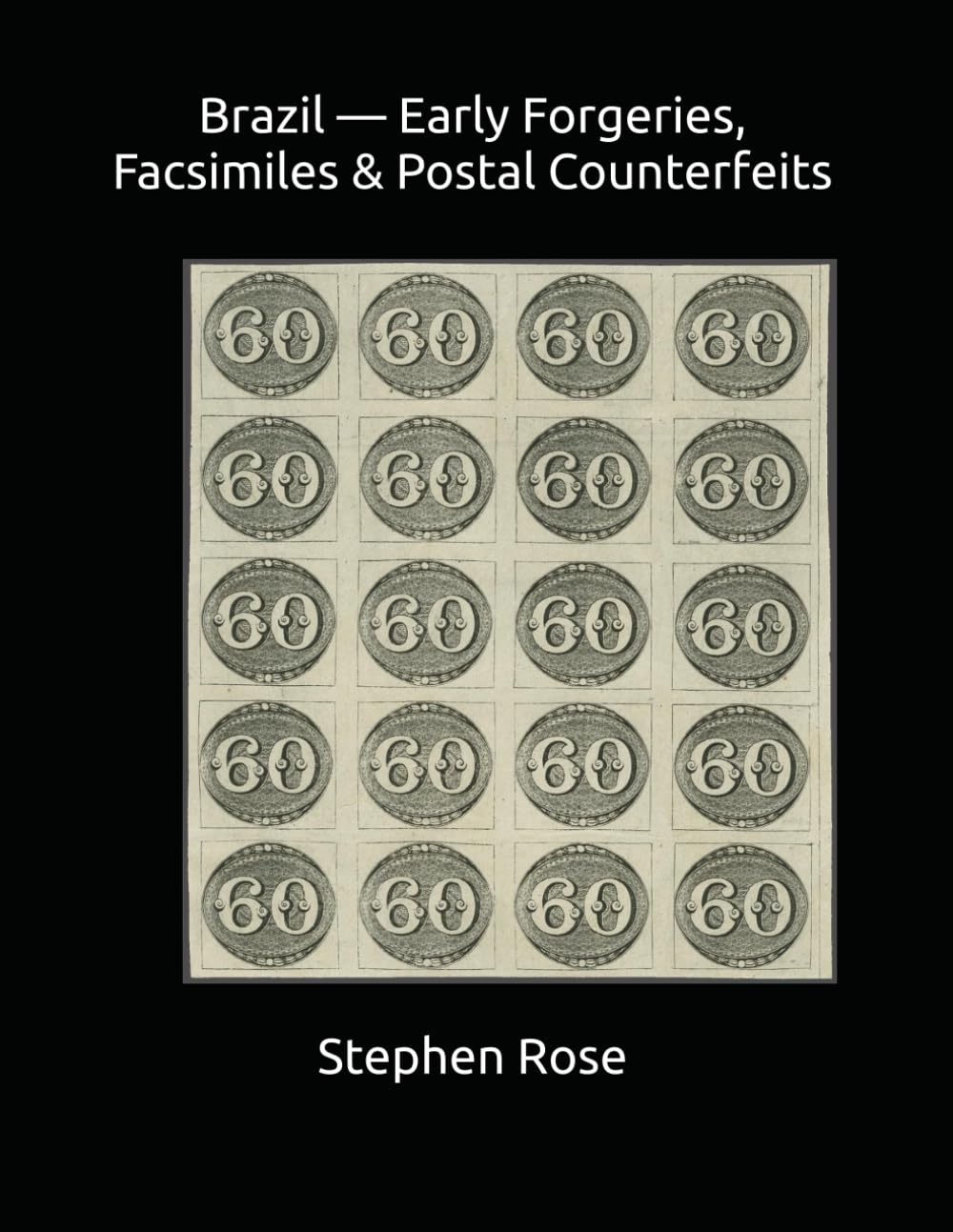
Stephen Rose Brazil — Early Forgeries, Facsimiles & Postal Counterfeits lit
por Stephen Rose



Escolha um formato:
| zip | Baixar grátis |
|---|---|
| rar | Baixar grátis |
| epub | Baixar grátis |
| Baixar grátis | |
| lit | Baixar grátis |
| odf | Baixar grátis |
Descrição do livro
This remarkable exhibit, the only one of its kind, sheds light on a lesser-known aspect of Brazilian postal history that is rarely seen.
This exhibit mirrors the early development of philately as a hobby and a business. Brazil was the second country to issue postage stamps. When the first issues of Brazilian stamps appeared between 1843 and 1861, philately had just begun its evolution from a children's past time to a global hobby. The scarcity of early Brazilian issues encouraged the production of facsimiles or imitation stamps. These early facsimiles were relatively crude productions. The following generation of forgers, especially those active during the first half of the 20th Century, created some truly deceptive imitations. Understandably, stamps as popular as the early Brazilian issues - coupled with their simple designs- and mostly "black color scheme- would be a continuing temptation to master forgers such as Foamier, Mercier, Speroti, and others who sought to remain anonymous.
This exhibit contains examples of all these materials.
Brazilian stamps from 1843-1861 are known collectively as the "numeral" issues. All 21 stamps consist of numerals of various sizes on a scrollwork background. The first set (1843) is also known as the Bull's Eyes. Later issues of this numeral series have also acquired suggestive animal nicknames: the Snake's Eyes of 1844, the Goat's Eyes (1850), and the Cat's Eyes (1854-61).
All Brazilian stamps released between 1843 and 1889 were engraved. The engraving process has two useful features: intricacy of detail and raised ink lines, which can be used to distinguish most forgeries. Engraving is a relative complex and laborious process. Most of the early facsimiles of the numeral issues were lithographed, which resulted in less detailed images with no ink ridges. Later, forgers used more sophisticated printing techniques like photo-etching and contact photolithography to create more exact reproductions.
The results of their artistry, especially Sperati's Bull's Eyes and Fourier's Goat's Eyes, are accurate enough to fool all but the most discerning collectors. There is no reliable evidence that any imitation of these early engraved issues was ever used as a postal forgery. The intended target was the individual collector, at first junior collectors who abhorred empty spaces in their albums; then, over time, as the value of early Brazilian stamps began to rise, the mainstream of philately.
As the 19th century ended, however, Brazil turned to cheaper techniques of lithography and typography to produce its stamps. These two processes offered fertile ground for counterfeiting. The first postal forgeries - designed to defraud the Mint rather than the collector also began to appear. These postal counterfeits are some of the most elusive items in Brazilian philately, with only a few surviving copies known in many cases.
Items of Special Interest in the collection include:
• Full sheets of the Spiro facsimiles.
• A complete set of the nine differe11t cancels on the Sperati Bull's Eye forgeries. plus signed proofs of his master dies.
• Sheets of both Fournier forgeries of the early postage-due issues (less than five known).
• A complete set of the Liberty Head postal counterfeits of 1900.
For students of Brazilian philately, this is a must-have. For students of philatelic forgeries, this is essential. For all philatelists, this is a high-quality textbook.









Autores populares
Icon Group International (402) Publishing lmgdaw (341) Nikolay Krechet (266) Unknown Author (197) Lyudmil Tsvetkov (179) Barrett Williams (166) Kennie B Journals (158) Riddler Books (122) ChatGPT ChatGPT (118) NAK Legal Publishing (116) Evgeniia Naumchenko (114) Sharifa McFarlane (97) Jillo Trukudo (96) Quick Witted Coconut (94) Roggie Clark (94) Mint and Cherry Notebooks (93) Marina Buchholz B.Eng (89) Iwona Makara (87) Mary Hirose (87) Kingston Publishing (85)