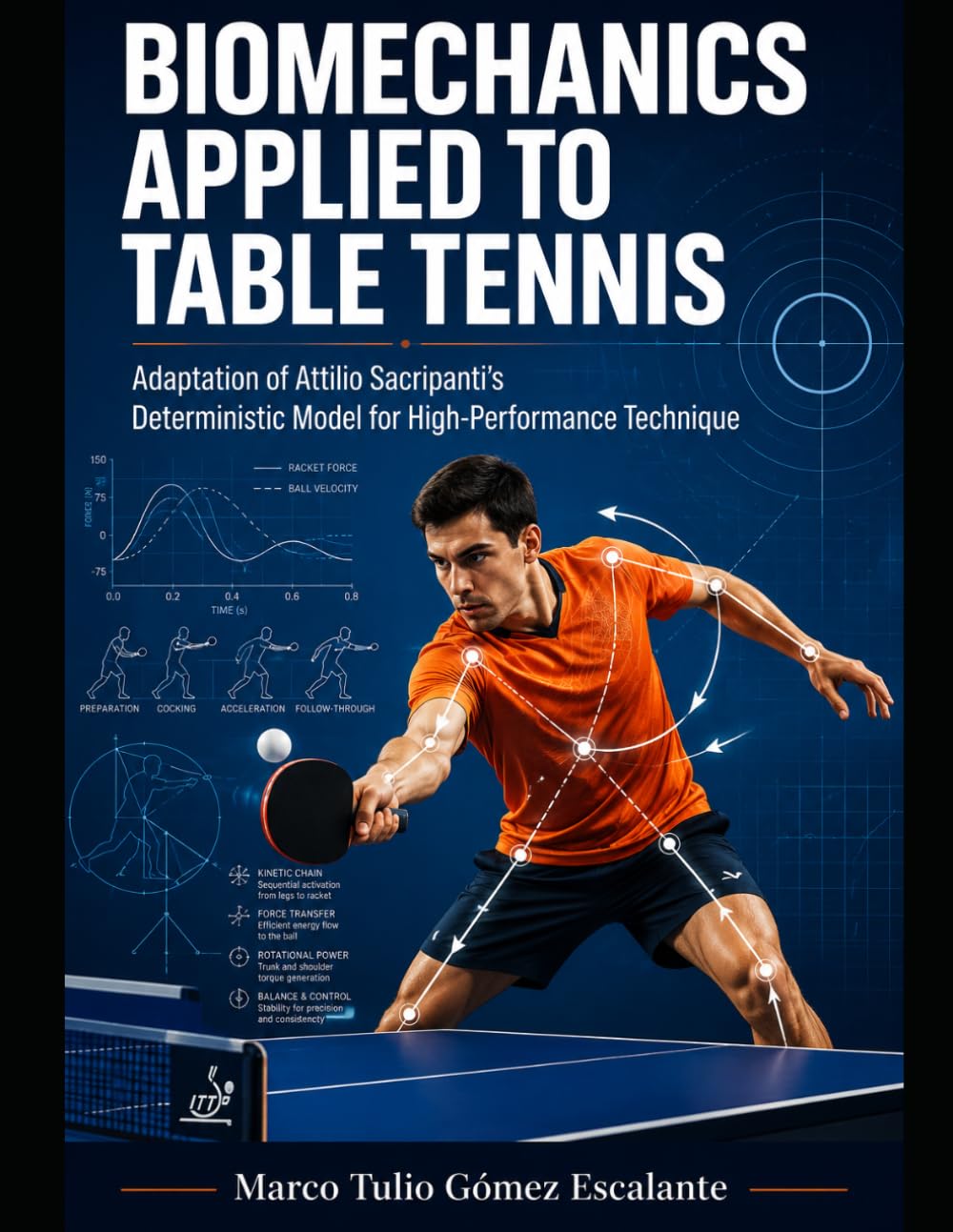
Biomechanics Applied to Table Tennis: Adaptation of the Deterministic Model baixar livro de graça
por Msc Marco Tulio Gómez Marco
Escolha um formato:
| zip | Baixar grátis |
|---|---|
| rar | Baixar grátis |
| epub | Baixar grátis |
| Baixar grátis | |
| lit | Baixar grátis |
| odf | Baixar grátis |
Biomechanics Applied to Table Tennis: Adaptation of the Deterministic Model
Biomechanics Applied to Table Tennis Table tennis is a sport of extraordinary speed, precision, and constant adaptation. Every stroke—from the serve to the most explosive topspin—is produced through the interaction of joint positions, kinetic chains, internal and external forces, reaction time, balance, motor control, and tactical intention. Biomechanics Applied to Table Tennis presents a systematic scientific framework for understanding these interactions. Inspired by Attilio Sacripanti’s deterministic biomechanical model, originally developed for judo, Marco Tulio Gómez Escalante adapts its mechanical principles to the technical and physical demands of table tennis. The book examines how variables such as force, torque, angular velocity, energy transfer, racket angle, center-of-mass control, coefficient of restitution, timing, and ground reaction forces influence the speed, spin, accuracy, and consistency of a stroke. Rather than merely describing movement, the proposed model helps explain why a technical action succeeds or fails. Readers will explore the biomechanics of the basic stance, footwork, forehand topspin, blocking, receiving, serving, impact, ball rebound, and recovery. The book also analyzes the kinetic sequence from the feet and legs through the hips, trunk, shoulder, arm, wrist, and racket, demonstrating how efficient coordination can increase performance while reducing unnecessary muscular effort. Applied case studies of elite players—including Fan Zhendong, Ma Long, and Hugo Calderano—illustrate how different athletes can achieve outstanding results through biomechanical solutions adapted to their individual playing styles, physical characteristics, and technical development. The final sections connect biomechanical analysis with training design, motor control, fatigue management, injury prevention, corrective exercises, video analysis, periodization, and long-term athletic development. Practical worksheets, diagrams, comparative tables, movement sequences, and assessment protocols help transform scientific concepts into concrete coaching decisions. Designed for coaches, players, physical trainers, sports scientists, students, and professionals working in performance development, this book builds a bridge between classical mechanics and the modern table tennis court. Biomechanics is not presented as an end in itself, but as a powerful tool for developing movement that is more efficient, precise, adaptable, sustainable, and less vulnerable to injury. Train with purpose. Analyze with science. Perform with efficiency.
Procurando Biomechanics Applied to Table Tennis: Adaptation of the Deterministic Model? Aqui você encontra tudo sobre este livro de Msc Marco Tulio Gómez Marco em 15 de agosto de 2026. Nesta página estão a descrição da obra, os detalhes da edição (122 páginas) e os formatos disponíveis para baixar: epub, pdf, lit, odf. O livro está escrito em Inglês. Se você gosta de Livros Internacionais, Esportes e Lazer, Esportes com Raquete, Tênis de mesa, explore também outros títulos da mesma categoria no Leitura em português. Veja ainda as outras obras de Msc Marco Tulio Gómez Marco em nosso catálogo.










Autores populares
Icon Group International (402) Publishing lmgdaw (341) Nikolay Krechet (266) Unknown Author (197) Lyudmil Tsvetkov (179) Barrett Williams (166) Kennie B Journals (158) Riddler Books (122) ChatGPT ChatGPT (118) NAK Legal Publishing (116) Evgeniia Naumchenko (114) Sharifa McFarlane (97) Jillo Trukudo (96) Quick Witted Coconut (94) Roggie Clark (94) Mint and Cherry Notebooks (93) Marina Buchholz B.Eng (89) Iwona Makara (87) Mary Hirose (87) Kingston Publishing (85)Idiomas populares
Inglês Espanhol Alemão Francês Português Italiano Japonês Polonês Holandês Sueco Russo Chinês Catalão Hebraico Multilíngue Tradicional chinês Espanhol, Inglês Alemão, Inglês Ucraniano Hindi